


TEMPE, Ariz. — Economic activity in the manufacturing sector expanded in May for the fifth consecutive month, say the nation's supply executives in the latest ISM Manufacturing PMI Report. Among the positive news, furniture and related products was one of the bright spots, while the wood products industry struggled.
The report was issued today by Susan Spence, MBA, Chair of the Institute for Supply Management (ISM) Manufacturing Business Survey Committee.
Here is a look at some of the categories surveyed and how furniture and wood products fare:
Furniture & related products, were:
- one of 16 manufacturing industries reporting growth in May;
- one of the 14 manufacturing industries that reported growth in new orders in May;
- one of the nine manufacturing industries that reported employment growth in May;
- one of the 14 manufacturing industries reporting slower supplier deliveries in May;
- one of the 10 industries reporting customers' inventories as too low in May;
- one of 16 industries that reported paying increased prices for raw materials;
- one of the nine industries reporting higher backlogs in May.
Wood products did not fare as well. Here is a look at how this industry fared:
- In terms of manufacturing industries reporting growth or contraction, wood products was the only industry reporting contraction in May;
- In terms of new orders, the only industry reporting a decline in new orders in May was wood products;
- In terms of production, the only industry reporting a decrease in production in May was wood products;
- Of the 9 industries that reported employment growth in May,wood products came in second;
- Wood products was one of six industries reporting lower inventories in May;
- It was one of 10 industries reporting customers' inventories as too low in May;
- The three industries reporting lower backlogs in May were wood products;
- Was one of eight industries that reported a decrease in new export orders;
- Was one of eight industries reporting higher imports in May.
Manufacturing industry overall
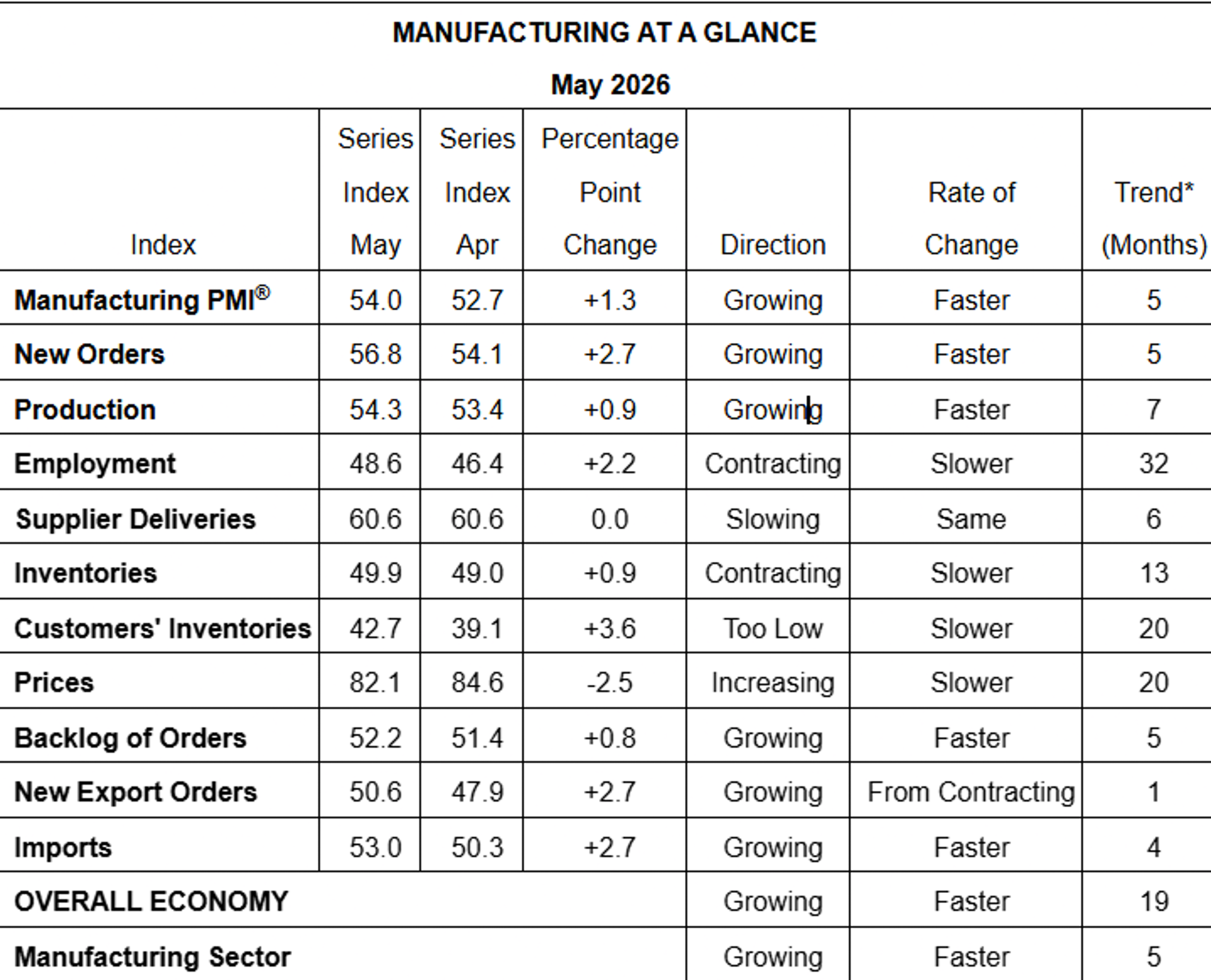
According to Spence, the ISM survey found new orders growing; production growing; employment contracting; supplier deliveries slowing; raw materials inventories contracting; customers' inventories too low; prices increasing; imports growing; and exports growing.
"The Manufacturing PMI registered 54 percent in May, 1.3 percentage points higher than in April and its highest reading since May 2022 (55.9 percent)," she said. "The overall economy continued in expansion for the 19th month in a row."
She added that a Manufacturing PMI above 47.5 percent, over a period of time, generally indicates an expansion of the overall economy.
The New Orders Index expanded for the fifth consecutive month after four straight readings in contraction, registering 56.8 percent, up 2.7 percentage points compared to April's figure of 54.1 percent. The May reading of the Production Index (54.3 percent) is 0.9 percentage point higher than April's reading of 53.4 percent. The Prices Index remained in expansion (or 'increasing' territory), registering 82.1 percent, a 2.5-percentage point decrease from April's reading of 84.6 percent. The Backlog of Orders Index registered 52.2 percent, up 0.8 percentage point compared to the 51.4 percent recorded in April. The Employment Index registered 48.6 percent, up 2.2 percentage points from April's figure of 46.4 percent," says Spence.
"The Supplier Deliveries Index indicated slowing performance for the sixth month in a row after one month in 'faster' territory. The reading of 60.6 percent repeated its April figure after the index increased in each of the previous five months. (Supplier Deliveries is the only ISM PMI Reports index that is inversed; a reading of above 50 percent indicates slower deliveries, which is typical as the economy improves and customer demand increases.)
"The Inventories Index registered 49.9 percent, up 0.9 percentage point compared to April's reading of 49 percent. The Customers' Inventories Index reading of 42.7 percent is 3.6 percentage points higher as compared to the 39.1 percent recorded in April.
"The New Export Orders Index returned to expansion territory with a reading of 50.6 percent, 2.7 percentage points higher than the 47.9 percent registered in April. The Imports Index registered 53 percent, 2.7 percentage points higher than April's reading of 50.3 percent."
Spence continues, "In May, U.S. manufacturing activity remained in expansion territory, growing at a faster pace compared to the month before. Of the five subindexes that make up the PMI®, the New Orders index indicated faster growth compared to the previous month, the Supplier Deliveries index stayed the same, the Production Index grew at a faster rate, and the Employment and Inventories indexes remained in contraction, though both improved.
"In May, 25 percent of the comments were positive and 69 percent negative, with a 1-to-2.7 ratio of positive to negative sentiment. Among comments, the Iran war was mentioned in 42 percent and tariffs in 18 percent; 57 percent of the panelists mentioned pricing volatility as an issue for their companies.
"Three of four demand indicators (the New Orders, Backlog of Orders, and New Export Orders indexes) were in expansion. The Customers' Inventories Index remains in 'too low' territory, contracting at a slower rate. A 'too low' status for the Customers' Inventories Index is usually considered positive for future production.
"Regarding output, the Production Index is in expansion for the seventh month in a row, and the Employment Index increased by 2.2 percentage points but remained in contraction. Among panelists, 50 percent indicated that managing head counts remains the norm at their companies, while 50 percent are hiring.
"Finally, inputs (defined as supplier deliveries, inventories, prices and imports) were mostly improved month over month. With the same reading as in April, the Supplier Deliveries Index stayed at its highest level since May 2022 (65.7 percent). The Inventories Index contracted at a slower rate, the Prices Index declined by 2.5 percentage points and the Imports Index grew at a faster rate.
"Looking at the manufacturing economy, only 2 percent of the sector's gross domestic product (GDP) contracted in May, compared to 19 percent in April, and the percentage of manufacturing GDP in strong contraction (defined as a composite PMI® of 45 percent or lower) was also 2 percent, the same as in April. The share of sector GDP with a PMI® at or below 45 percent is a good metric to gauge overall manufacturing weakness. All of the six largest manufacturing industries expanded in May, in the following order: Computer & Electronic Products; Machinery; Transportation Equipment; Petroleum & Coal Products; Chemical Products; and Food, Beverage & Tobacco Products. In May, all indexes headed in a direction that suggests sustained growth," says Spence.
The 16 manufacturing industries reporting growth in May — listed in order — are: Printing & Related Support Activities; Textile Mills; Nonmetallic Mineral Products; Paper Products; Electrical Equipment, Appliances & Components; Plastics & Rubber Products; Primary Metals; Miscellaneous Manufacturing; Computer & Electronic Products; Furniture & Related Products; Machinery; Transportation Equipment; Petroleum & Coal Products; Chemical Products; Fabricated Metal Products; and Food, Beverage & Tobacco Products. The only industry reporting contraction in May is Wood Products.


Have something to say? Share your thoughts with us in the comments below.