

It seems everybody in this industry talks about the lack of skilled workers. People complain about nobody wanting to work in the industry and schools that have abandoned woodworking programs.
Sure, there are strong efforts like the National Woods Board and the Woodworking Career Alliance that are specifically focused on training people to work in the industry, but I think there is a fundamental issue that most of us overlook. That’s the increasing alienation I see in the general populous when it comes to appreciation or understanding about wood itself and the things that can be made from it.
I also think that it’s time we all, as individuals, need to take personal responsibility for change.
I’m not talking just about sending off a check to the NWB or WCA, although that is a good idea, and they would appreciate any and all donations. This is an obligation that can’t be bought. It needs to be shared one-on-one, one-by-one, and hands-on. I’m talking about teaching.
For a number of years, I taught adult education woodworking in a nearly derelict middle-school shop. While I taught mostly adults, I also took on kids who wanted more than the declining day woodshop program could deliver. When the day teacher retired, I had to fight the school district to save the shop.
The new “technology” teacher was scared of the “dangerous big machines” like the 8-inch jointer, 10-inch table saw, 15-inch planer, 18-inch bandsaw, and three wood lathes. He wanted no more serious woodworking equipment than a trio of scroll saws. His idea of woodworking was cutting popsicle sticks on the scroll saws and hot-melt-gluing them together to make bridge models. There was nothing in his program to teach the fundamental concepts of wood joinery and making precise parts that fit together exactly.
I convinced him to let me put on a demonstration workshop for his 8th-graders. I set up stations around the shop each dedicated to simple joinery. There was a biscuit joiner, a dowel jig, a tongue and groove setup using an old Stanely No. 48 plane, and even an Invis demo showing invisible fasteners driven together with magnetic power.
Everybody had a great time making parts that actually fit together. They learned about the importance of precise measurement and how wood grain has a direction. They earned powerful feelings of accomplishment. And nobody cut their fingers off.
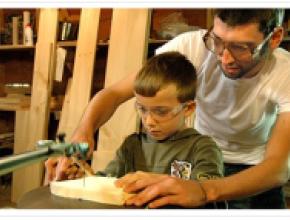
For several summers, I also taught a weeklong woodworking program for girls and boys in first through fourth grades. We used all hand tools and made a simple project every day for five four-hour sessions. The last project was a tool tote that they took home with a list of all the tools they learned to use in the class and instructions for their parents to fill the tote with tools and continue the lessons at home.
I was reminded of all of this when I got a call from a summer camp in Maine looking for a woodworking instructor. It sounded like fun, but it also sounded like something we all should be doing to pass on the love and understanding of woodworking.



Have something to say? Share your thoughts with us in the comments below.